
Air Column Packaging vs. Bubble Wrap: Which Protects Electronics Better in Transit?
· by Redaktion
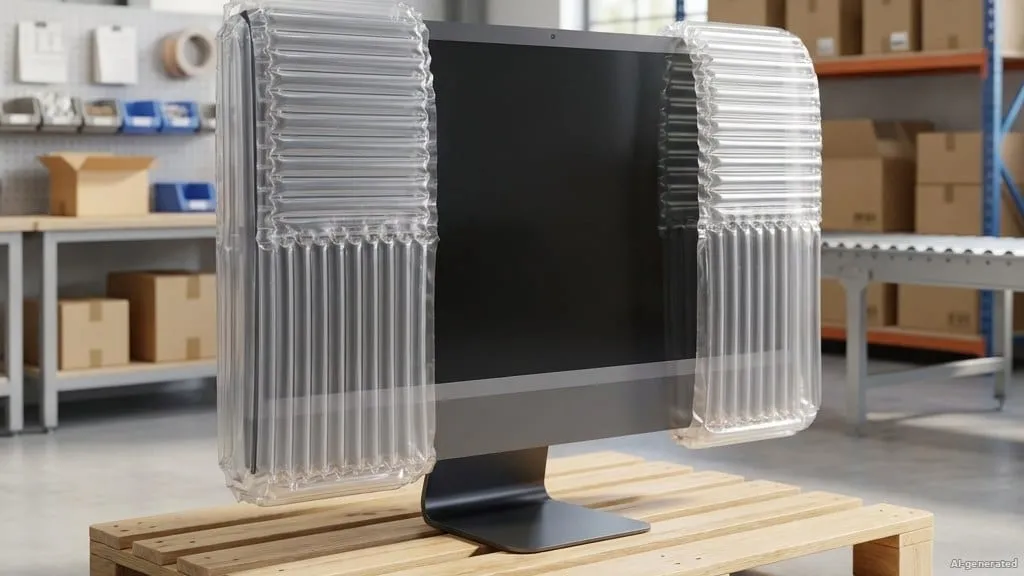
For most electronics shipments, air column packaging protects better than bubble wrap because it surrounds the product with inflated air chambers that immobilize it and absorb drop and vibration forces on every side. Bubble wrap relies on many small pockets that can burst, flatten, or shift, leaving corners and edges exposed. If a laptop, display, or circuit board absolutely has to arrive intact, engineered air chambers give you more consistent, repeatable protection.
Shipping electronics is unforgiving. A cracked display, a bent connector, or a hairline fracture on a board turns into a return, a refund, and a lost customer — and the damage rarely shows up until the box is opened. That is why the choice of cushioning matters more than most teams assume. Below, we compare air column packaging and bubble wrap the way a fulfillment or warehouse manager actually evaluates them: protection, cost per parcel, and what happens in the recycling bin.
Why does air column packaging protect electronics better than bubble wrap?
Bubble wrap works by trapping air in a grid of small bubbles. The idea is sound, but the execution is fragile. Bubbles burst under pressure, migrate away from the product as the parcel is handled, and often leave the most vulnerable parts — corners, edges, and connectors — thinly covered or fully exposed. To compensate, packers tend to wrap more and more layers, which drives up material use and adds dimensional weight without a matching gain in protection.
Air column packaging takes a different approach. Instead of many tiny pockets, it uses a series of larger, connected air chambers that inflate around the product and lock it in place. Because the chambers are engineered as a system, the cushioning stays where it belongs during transit. When the parcel is dropped or jostled, the air columns flex and redistribute the impact rather than transmitting it straight into the device. You can see this side by side in our air column packaging in action examples, from laptops and displays to toner cartridges.
The mechanics are simple to grasp once you see how UNIQBAG works: you insert the product, inflate the air columns, and ship it protected. Three steps, repeatable at every packing station, with far less guesswork than freehand wrapping.
How do air column packaging and bubble wrap compare on cost and sustainability?
Protection is only half the decision. The other half is what each option costs you across a full shipping operation — and increasingly, how it affects your sustainability profile.
Start with material. Bubble wrap is bulky to store and easy to over-apply, and rolls take up space long before they are used. Air column packaging ships and stores flat, then inflates only when you need it, so you are not paying to warehouse air. Because the UNIQBAG benefits include reducing dimensional weight by up to 30%, tighter, better-fitted packaging can translate directly into lower parcel-carrier charges — DIM weight is what many carriers actually bill on.
Then there is the end of the line. Traditional bubble wrap and mixed foam are notoriously awkward for customers to recycle, and that friction shows up in reviews and brand perception. UNIQBAG air column packaging is curbside recyclable, which makes disposal simple for the person opening the box and keeps your unboxing experience clean.
If your goal is to cut plastic further, you have options within the same lineup. PaperEZ Bubble paper cushioning offers a plastic-free protective alternative, and the MINI AIR PRO2 air cushion machine lets you produce cushioning and void fill on demand right at the packing station instead of stockpiling pre-made material.
Related to this article: Air Column Packaging in Action | Protection for Electronics & Glass | UNIQBAG Discover UNIQBAG air column packaging in action: Secure inflatable protective packaging for laptops, wine, toner & displays. The modern alternative to bubble wrap. Reduce DIM weight & shipping costs. More about Air Column Packaging in Action | Protection for Electronics & Glass | UNIQBAG →
When should you switch from bubble wrap to air column packaging?
The switch pays off fastest when three things are true: your products are fragile or high value, your damage or return rate on shipped goods is higher than you would like, and your parcels are being billed on dimensional weight. Electronics check every box. So do glass, spare parts, and sensitive instruments.
You do not have to overhaul your whole line on day one. The most reliable way to decide is to test with your actual products, your actual boxes, and your actual carriers, then compare damage rates and packed dimensions against your current bubble wrap process. If your items have unusual shapes or need a very specific fit, engineered custom air column packaging can be developed to match — from analysis through to a drop-test certified, production-ready solution.
Frequently Asked Questions
Is air column packaging really better than bubble wrap for shipping electronics? In most cases, yes. Air column packaging holds the product in place with connected, inflated chambers that cushion impacts on every side, while bubble wrap can flatten, burst, or shift and leave corners exposed. For fragile, high-value electronics, that consistency is the deciding factor.
Does air column packaging cost more than bubble wrap? The material comparison depends on your products and volumes, but air column packaging ships and stores flat and can reduce dimensional weight by up to 30%, which often lowers what carriers bill per parcel. Fewer damage-related returns further improve the total cost of shipping, not just the price of the cushioning.
Is UNIQBAG air column packaging recyclable? Yes. UNIQBAG air column packaging is curbside recyclable, so the customer opening the box can dispose of it easily. If you want a plastic-free route, PaperEZ Bubble paper cushioning is available as well.
Can I get packaging sized exactly for my product? Yes. UNIQBAG develops custom air column packaging to fit specific products and shipping requirements, from the initial analysis through to a drop-test certified, production-ready solution.
What is the easiest way to try it before switching? Test it with your own products. You can order the UNIQBAG test kit to run a real-world comparison against your current bubble wrap, or request a custom solution if your items need a tailored fit.
Ready to stop shipping cracked electronics? Request your custom packaging solution and describe your product and shipping challenge — UNIQBAG will engineer air column protection built around it.
Transparency note: This article was created with AI assistance and reviewed by our editorial team. The article image is AI-generated.